Executive Summary
For stable joint strength in PPR (Polypropylene Random Copolymer) pipe systems, maintaining the correct fusion temperature and welding parameters is non-negotiable. Incorrect temperature or insufficient heating time leads directly to leakage, joint failure, and warranty disputes. Below is a clean, manufacturable reference for technicians and QA teams.
Optimal Fusion Temperature for PPR Pipes
| Material | Recommended Heating Plate Temperature |
|---|---|
| PPR (Polypropylene Random Copolymer) | 250 °C – 270 °C |
| PE / HDPE (for comparison) | 200 °C – 220 °C |
Standard industry temperature window for PPR is 260 °C ± 10 °C.
Why not exceed 270 °C?
Because temperature above the limit carbonizes the polymer, weakens the internal structure, and forms brittle joints. Lower than 250 °C leads to incomplete fusion.
Three Environmental Variables That Influence Welding
Fusion performance changes with:
- Ambient temperature
- Humidity / moisture on pipe surface
- Airflow / wind at the job site
| Environmental variable | Welding impact |
|---|---|
| Low temperature (below 5 °C) | Material absorbs heat faster → requires longer heating time |
| High humidity or condensation | Moisture blocks heat transfer → requires longer heating time and complete drying |
| Wind / outdoor installations | Heat loss from the heating plate → may require slightly higher temperature or extended heating time |
Key rule: Poor conditions → extend heating time (and in extreme cold, increase temperature slightly).
Welding Process Overview
- Calibrate the welding machine to 260 °C.
- Cut, chamfer, and clean pipe and fittings (any dust or water destroys weld quality).
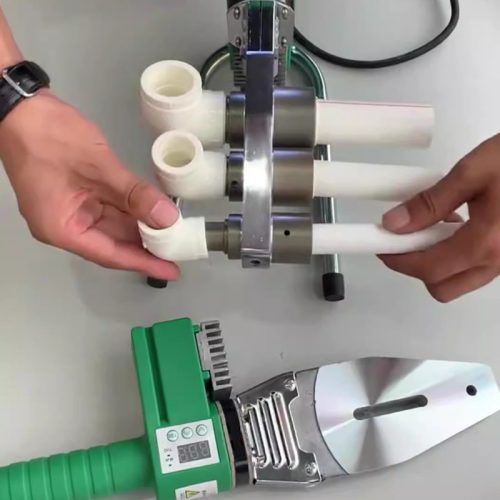
- Insert pipe and fitting into heating die simultaneously.
- Heat according to table parameters.
- Insert socket without rotation — rotation breaks the fusion layer.
- Cold-set the joint — do not move, bend, or pressurize during cooling.
Welding Parameter Table (16 mm – 160 mm)
Values apply to normal ambient conditions +5 °C to +40 °C.
If temperature is below 5 °C, increase the heating time by 5–10%.
| Pipe Outer Diameter (mm) | Welding Depth (mm) | Heating Time (seconds) | Socket Insertion Time (seconds) | Cooling Time (seconds) |
|---|---|---|---|---|
| 16 | 14 | 5 | 4 | 30 |
| 20 | 14 | 5 | 4 | 30 |
| 25 | 15 | 7 | 4 | 30 |
| 32 | 16 | 8 | 6 | 120 |
| 40 | 18 | 12 | 6 | 120 |
| 50 | 20 | 18 | 6 | 180 |
| 63 | 24 | 24 | 8 | 240 |
| 75 | 26 | 30 | 8 | 240 |
| 90 | 29 | 40 | 8 | 360 |
| 110 | 32 | 50 | 8 | 360 |
| 125 | 34 | 60 | 10 | 480 |
| 160 | 36 | 80–90 | 12 | 600 |
Instructions:
- Heating time “refers to placing both the pipe end and the fitting end in the heating plate/sleeve at the same time until a melting ring can be formed.
- Assembly time “refers to the number of seconds after removing the heating plate, during which the pipe is inserted into the fitting and maintained in a pressed state.
- Initial cooling maintenance “refers to the number of seconds required to fix the position after insertion to prevent displacement and deformation.
- The ‘complete cooling time’ is the recommended waiting time before applying pressure to the system to ensure that the weld is cooled to a suitable state at ambient temperature.
Typical Welding Defects and Causes
| Defect | Root Cause | Corrective Action |
|---|---|---|
| Joint leakage after pressurization | Heating temperature too low or heating time too short | Keep plate steady at 260 °C; follow table values |
| Brittle joint / cracking after installation | Overheating > 270 °C | Reduce temperature to target range |
| Poor bead or incomplete melt | Dust, grease, water inside pipe | Always clean before fusion |
| Misalignment / poor insertion depth | Rotating during insertion | Insert directly without rotation |
Specific welding issues can refer to this article:Common problems and causes of PPR pipe fusion welding
Adjusting the welding time is also very important.
Temperature and time are interconnected:
- Lower temperature → Extend heating time
- Cold environment → Extend heating time
- Humid environment → Reduce insertion force to prevent steam from affecting the weld layer
- High winds outdoors → Maintain a constant heating plate temperature and appropriately extend cooling time
Cooling time is not fixed. Larger pipe diameters (90–160mm) or cold environments require longer cooling cycles; otherwise, internal stress may cause micro-cracks, leading to leaks later.
If you need to weld in winter, you can refer to this article:Winter Welding Precautions for PPR Pipes
Final Message
The secret to stable welding isn’t memorizing a number, but rather:
Use a working range of 250–270 °C
Dynamically adjust heating and cooling times according to the environment
Determine if fusion conditions have been met based on the material’s condition
PPR welding is not a rigid process, but a combination of technique and experience.
Refer to this article for welding instructions on using PPR.Master the core plumber s welding pipe skills How to Weld PPR Pipe Fittings
Safety precautions for PPR welding:Safety reminder label for PPR welding machine
References
ISO 15874-3:2013 Plastics piping systems for hot and cold water installations — Polypropylene (PP) – Part 3: Fittings → https://cdn.standards.iteh.ai/samples/54157/fe2f8d75f85d4f1f89c0fe6c927fceee/ISO-15874-3-2013.pdf
Chevron Phillips Chemical – Heat Fusion Joining Procedures and Qualification Guide(Involves the control of welding temperature, time, and cooling for plastic pipes) → https://www.cpchem.com/sites/default/files/2021-07/PP%20750%20Fusion%20Procedures%20June%202021_CRUpdate_onWebsite_1.pdf